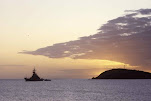
Sixteen year old Abby Sunderland has been rescued in the Southern Ocean. She failed in her attempt to become the youngest person to sail non-stop, single handed, around the world. Having had to stop in Cape Town for repairs, she decide to complete her voyage, even though she wouldn't be setting any records. In the final analysis, Abby's voyage was a stunt. It's true that people have been sailing, single handed, in the open ocean, for a good long time, but most had a heck of a lot more experience than Abby. The real key to understanding Abby's level of comfort and experience was hearing how unnerved she was when she got up one morning, to find that she couldn't get the engine started to charge the batteries for the auto pilot. Gosh. Maybe that cute little solar panel wasn't up to the task. The most critical emergency skills for any open ocean sailor (aside from pure survival), even for relatively short, point to point voyages, would be alternative rigging and self steering arrangements. It doesn't sound like Abby was too strong in the second area. I suspect that Abby never would have undertaken this voyage before the era of GPS, satellite phones, and SARSAT (oh, and, yes, high tech, low drain auto pilots). Can you imagine this voyage thirty years ago, with her parents anxiously awaiting a phone call from a ship's agent, stating that the S.S. "such and such" had passed Abby's boat, that she was fine, and sent her greetings?
There is no chance that sixteen year old Abby could have accumulated enough off shore sailing experience to have undertaken her voyage safely. That doesn't mean that she couldn't complete her voyage. Two teenagers had recently done so, and Abby was off trying to break their "records", but I'd suggest the following. For the experienced mariner, completing such a voyage, in a small sailboat (rather than a large, ocean going sailing vessel), is probably fifty per cent seamanship, and fifty percent luck. Having spent a career at sea in naval vessels, I've seen too many things, natural and man made, that can do-in a small sailboat (yes, even one of sixty or eighty feet). There are floating containers, lumber, logs, steel construction pilings, other miscellaneous escaped deck cargo, whales, ships with negligent or (apparently) non-existent deck watches, large waves, out of synch waves, and the list goes on. A careful inspection of Abby's boat suggests that, while she may have had seamanship skills, to a great extent, she was presiding over a collection of machinery and technology.
On 25 April, Abby wrote in her blog:
"I have some big news today. It's not necessarily good news, but the way I look at it, it's not bad either. I am going to be pulling into Cape Town for repairs thus ending my non-stop attempt. My whole team and I have been discussing whether or not I need to stop ever since my main auto pilot died. It's one thing to sail across an ocean with one well-working auto pilot, it's another to keep going with one that is not at all reliable. It would be foolish and irresponsible for me to keep going with my equipment not working well. I'm about 10-14 days from Cape Town right now and though my auto pilot is working for now, we're all holding our breath and hoping it will last."
Well, that's just fine. She did get the foolish part correct. Perhaps Dad should have bought her a copy of "Self Steering for Sailboats." How about a series of emergency procedures, one of which begins with "the electrical system shorts out." Perhaps she didn't need these procedures, because each one would say the same thing: "Replace with spare" or "activate emergency beacon." It didn't matter; Abby's voyage came to an end due to a dismasting, not due to a breakdown in technology, but her reliance on technology suggests that she might have needed about eighty percent or more luck in her bag of tricks.
So, Abby and her family were smart enough to get paying sponsors for her voyage, and she was brave enough to go to sea alone, but either not smart enough, or not experienced enough to know that she shouldn't have. She's alive because she went to sea in the twenty-first century. The captain of the ship that rescued her got washed into the water during the rescue. The time to unconsciousness in 40 degree F water is about fifteen minutes, so he got lucky, even in a survival suit. How easy do you think it is to rescue someone thirty foot seas? How easy do you think it is to injure someone while trying to fish a person out of the drink in thirty foot seas? Was Abby worth it? It doesn't matter. No mariner will fail to attempt to rescue another mariner in distress. As for Abby's publicity hungry parents - someone should teach them the wicked hard lesson that they were unwilling to teach their over indulged daughter.
Stunt. Bring on the next publicity seeker.
Saturday, June 12, 2010


Thursday, June 10, 2010
Turkish Politics, Israel, and a Little Self Delusion
A recent Wall Street Journal article about Mr. Erdogan, the Turkish Prime Minister, is a nice compliment to my recent comments on Turkish sponsorship of the recent effort to break the Israeli "blockade" of Gaza. I use the term blockade because that is the term in general usage in the international press. I place it in quotes because it seems to me to more resemble a quarantine, since some items are permitted in. Kindly see the article below, noting the following: Turkey is nowhere near as much a western country as Europeans and Americans would like to think. While all countries have national myths, Turkey's may be uniquely powerful, and most significantly, uniquely at odds with the truth. I'll admit my bias - as a child, I knew a survivor of the Armenian genocide (sorry, for all you Turks, it's just the "Joint Turkish-Armenian Misunderstanding).
For the full story, please see: http://www.meforum.org/2668/erdogan-and-the-israel-card
For the full story, please see: http://www.meforum.org/2668/erdogan-and-the-israel-card
Sunday, June 6, 2010
My Take On The Recent Turkish Sponsored Attempt to Break the Israeli Blockade of Gaza
Note: This was slightly revised on 7 June
My Take On The Recent Turkish Sponsored Attempt to Break the Israeli Blockade of Gaza
My take appears to be unique, so I wonder that I might be way off, but I'm throwing it out there, because it smells right, and in the condemnation of Israel I smell a rat. Rather than argue the case in a narrative, I intend to begin by presenting certain facts.
1. The government of Gaza has publicly committed itself to the destruction if Israel. While it is not currently launching rockets at Israel, it has done so in the past, and takes no measures to deter its citizens from doing so now. As such, the government of Gaza constitutes a belligerent.
2. Israel has imposed a blockade against a belligerent that she is facing. Suggesting that the blockade is illegal collective punishment suggests that people are not responsible for the government that they have elected.
3. The sponsorship of the mission to break the Gaza blockade by a Turkish charity with close ties to the Turkish Prime Minister, Mr. Recap Erdogan, is not a coincidence. The current Turkish government has been steadily pushing Turkey into the Islamist camp. Having once been disqualified from running due to its non-secular nature, the current Turkish ruling party (the bJustice and Development Party, or AKP) carefully cleansed itself externally, so as to qualify for the ballot. Having won the election, they began purging the military at the senior and mid grade officer level. Officers at these levels have traditionally seen themselves as guardians of the modern Turkish secular state. The party, having now protected themselves from the guardians of secularism, has moved to permit more overt public expressions of Islam. They are beginning to dismantle the modern Turkish secular state. They also canceled joint military exercises with Israel, and began close military cooperation with Iran and Syria. The sponsorship of the Gaza blockade run was just the most recent effort on the part of Turkey to make its bones in the Islamist world. The fact that people on board the Turkish Ferry Marvi Marmara were able to incite violence (the pipe swinging folks on deck are pretty good evidence, unless the Israelis faked it) just solidified the Turkish position. They now have solid Islamist credentials, and can continue dismantling Ataturk's state.
What does this mean for NATO? A member state is now exchanging military information with two strong supporters of state terrorism. Hey, you be the judge. While you're at it, for extra credit, judge whether NATO itself has a future.
Tuesday, May 18, 2010
Laying in Cider
It's done for the year. After months of fermentation, aging, and a bit of procrastination, the cider is bottled. Honesty requires that I admit that the only reason the task is done is that my wife got me going, then did half the work.
Hard cider isn't much appreciated in most of the country. There is at least one commercial variety available in this area, though you have to look hard for it. Last year I bought a bottle, just to compare the commercial product with my home brew. I was astonished at how much better the home brew product was. Unlike beer, making hard cider requires no cooking, no recipe per se. The most important element is the raw material, the unpasteurized apple cider. The hard cider cannot taste better than this raw material. If your experience with cider is limited to the highly clarified, pasteurized product, sometimes available in the supermarket, then you have no experience with a superior product. This superior product is getting more difficult to find; the federal government is making it more difficult to sell. The feds would prefer to see nothing but pasteurized, highly preserved “cider”, with all hazard to the user engineered out, along with all the flavor. Eventually, either the federal government, or the right product liability lawyer, will probably end commercial cider production altogether. Against that day, I've designed my own cider press. In my opinion, the cider we have in my area of Virginia is as good as any I've ever tasted.
In the family of fine alcoholic beverages, I put cider in the wine class. My first year's production tasted like a very dry apple wine. Given how full flavored my raw material was, I was surprised at how light the final product tasted. It was good enough to prompt a change in method this year. We made four batches, some with extra sugar added, to increase the alcohol content, and two different strains of yeast. Preliminary tasting, at bottling, suggests that the results will surpass last year's.
As with any product that must be fermented, then aged, only time will tell the final quality. We'll get our first real look in about six months, just in time for Thanksgiving.
Sunday, May 16, 2010
Where is The European Economic Crisis Going?
Where is The European Economic Crisis Going? I wish I knew the answer to this question. It would permit me to speculate, and perhaps become rich. The central issue is no longer the Greek economy, or Greece's inability to control its debt and budget deficit. Greece is now merely the light with which the overall crisis is being illuminated. The core issue may be the fact that, given our level of knowledge about the crisis, no one has the slightest idea what the euro is worth. The daily valuations of the euro on world currency markets amount to blind wanderings, and will continue thus until the markets are satisfied that the true depth and breadth of the crisis are known.
Here's a very little history. In the beginning, entry into the European common currency zone was to be restricted to those countries that could keep their annual budget deficits under three percent of GDP. This, plus a lick and a prayer, would be enough to bind together such disparate economies and cultures as Italy and Germany. Italy, where paying taxes is approached with good natured humor, and little compliance; Germany, where taxes are paid, and inflation is considered the ultimate enemy. There seemed to be no question that all EU members would be welcome in the eurozone, even before any had complied with the deficit requirement. We can't, at this point, prove that any eurozone countries weren't in compliance when they adopted the euro. However, we can prove that very few of these countries have kept their deficits under three percent of GDP for more than a year since adoption. It's a similar smoke and mirror routine to that employed in the United States, to disguise the size of the annual budget deficit.
Here's a little current reality. Every time the EU lifts its skirt to show a bit more of the truth, we see just a little more than we were supposed to see. Have Spain and Portugal really “fixed” their deficit problems quite so easily, with so much less unrest than Greece has, and is suffering? We will eventually have to know.
Want a little reinforcement? On 16 May, German Chancellor Angela Merkel stated that (with the bail out fund) “we have done nothing more than to buy time until we have brought order to these competitive differences and to the budget deficits of individual euro countries.” Competitive differences, eh? Who knew that there were competitive differences between the German and Greek economies. I'd like to hear the barest outline of a plan to “bring order” to that.
Until the full extent of he eurozone sovereign debt crisis is understood, there is no way to value the euro. If the crisis, and information deficit, persist for much more than a month, the euro could easily reach parity with the dollar. That would be quite a fall. In fact, it could become a free fall.
Peace and love.
Thursday, May 13, 2010
The End of America's Time
A supposedly smart person recently remarked to me that the United States, in many ways, resembled England after World War II. She spoke of England groaning under her war debt after 1945, and her final realization, during the Suez crisis, that the empire was finished. All this is true, but it may not correspond that well to the United States' current position. All the above is true, but England was really done after World War I. She had a great fleet in being, and a remarkable empire that was at or near its maximum reach. Her traditional enemy, Germany, was prostrate, and on the verge of experiencing revolution and inflation that is still the example of what to most fear in economic policy.
England had crushing war debts, much of it to the United States. She repudiated much of them, which earned her no new friends across the Atlantic. But the final, crushing blow was the League of Nations, whose mandates gave England sway over former Ottoman provinces that were nothing but trouble. Elie Khedouri, in “The Chatham House Version,” describes how England desperately wanted to be free of these mandates well before they were scheduled to expire, for they were costing her dearly, at a time when she could ill afford the cost. One result of England's burden was her inability to rearm in the face of a rearming Germany. In fact, even before Germany began rearming, the British Parliament had passed the secret Ten Years Rule, or Pernicious Law (as its opponents called it). The Ten Years Law stated that England could count on ten years warning for a major war, hence, there was no need to further arm or modernize the military until such warning was received. The law was renewed each year (also in secret), pushing the ten year window one more year into the future. That didn't work out too well for them.
The United States has no mandates such as England had, but we do have active and serious military commitments throughout the world. These commitments are crushing. Additionally, every world wide humanitarian crisis demands US attention, both in terms of direct aid, and broad (and expensive) logistics support. It's possible that most of the world doesn't realize the magnitude of the task to move thousands of tons of supplies, whether munitions or food aid, from one point to another in rapid order. The United States has done this frequently, during humanitarian crises going back to 1947. The expense is immense; the cost comes right out of the defense budget. The great expense of flying large quantities of material is lost on most people, but it's not just a matter of money. You must have the equipment and expertise, as well. Owning and maintaining the equipment to do all this is, in itself, remarkably expensive. Even if we are reimbursed for the costs of transporting such aid, the wear and tear on our transport capability shortens the service life of equipment, creating additional hidden costs.
Given our debts, our hollowed out industrial infrastructure, and our appetite for more and more domestic spending, there will come a point when, even pictures of starving, beaten women and children on the nightly news will be insufficient to bring forth US aid.
Then, who will be the pillar of the free world.
Tuesday, May 11, 2010
The End of Federalism
Educated observers of the United States like to talk about federalism, that is, the relationship between the Federal Government of the United States and individual states. Many wax poetic about the states as laboratories of the democratic process. Let's end such talk right now. Permanently. There are no more states as meaningful legislative entities. What Lincoln began with the Civil War, and Roosevelt refined with the New Deal, has been finished by the post World War II federal government that has a program for absolutely everything, from child health care to high school homework. The federal government may be broke, but the steady stream of money from the US Treasury to the states continues to flow, even if the feds must keep an extra shift on just to print enough of those phony bucks. The Constitution may limit the power of the federal government, but failure of a state to adhere to even one bizarre federal regulation can mean loss of all federal aid. Since the states are equally broke, but unable to print their own money, they must tow the federal line, or lose the federal aid to which they have become highly addicted. The result? There ain't no states. There are jurisdictions where a local government functions by sufferance of Washington, but the states can no longer do ANYTHING if the feds object.
End of song. End of states. Why bother with the fiction? Have a nice day.
End of song. End of states. Why bother with the fiction? Have a nice day.
Subscribe to:
Posts (Atom)